Biomimicry models
Supporting the design of an innovative, resilient organisation
Cristóbal Vila, Nature by Numbers
Models turn up everywhere in nature. One of the best known is the golden ratio. After Euclid and Plato, countless others studied it — Kepler, Luca Pacioli, Roger Penrose and, not least, Leonardo of Pisa, known today as Fibonacci. Mark Barr gave the ratio the Greek letter Φ, the first letter of the name Phidias, the Greek sculptor who lived from 490 to 430 BC and is thought to have applied the golden ratio in his work. The Fibonacci sequence (1-1-2-3-5-8-13 and so on) appears in nature surprisingly often, as does the logarithmic spiral derived from it. Below is a film by CosmicContinuum with a great many examples:
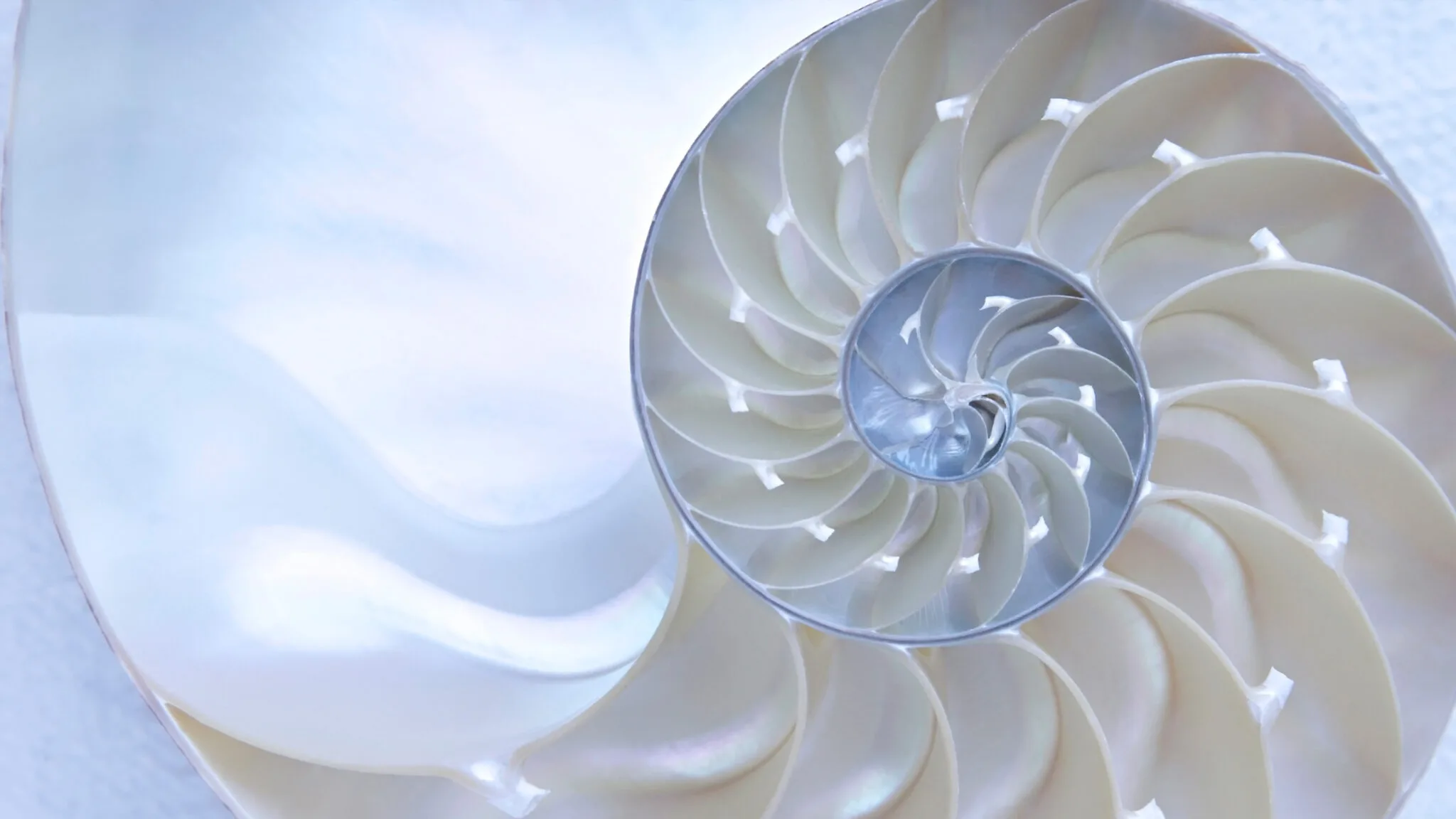
Alongside the golden ratio as a mathematical model, used in architecture and in product design, the nautilus shell is the basis for our design spiral. It gives us a handle on designing from a natural perspective. The advantage of an innovation process led by biology is that we can look to working examples in nature, confident that the design holds up — otherwise the organism would have died out.
Every new design brings a process of change with it. The cycle of the 5 O change model repeats regularly, just as it does in nature. An organism stays in a continuous state of change, which lets it adapt quickly and effectively when it has to. An innovative, resilient organisation needs that same principle — hence the natural 5 O change model:
These are some of the models and techniques we apply in building a resilient organisation. Would you like to know more? Do get in touch.